Dr. Elena has joined our group as postdoc and she will stay with us during the next year.
Welcome Elena.
Our Prolinol Study Featured in “Campusa”!
Campusa, the Journal of the University of the Basque Country (EHU), has published a press release ab…
News on Astrobiology.com
Our recent work on the emergence of prebiotic chemistry in the interstellar medium (ISM) has been hi…
Dr. Carla Casadevall presents her research to our group
Dr. Carla Casadevall, Assistant Professor and Group Leader at the Universitat Rovira i Virgili and t…
Emilio J. Cocinero visited University of Rioja
Emilio J. Cocinero visited the University of La Rioja this Monday to give a seminar related to high‑…
Our group participated in the 8th Glycobasque Conference
Our research group attended the 8th Glycobasque Conference, held on October 23rd and 24th at …
Recent Posts
Aran Insausti got the Basque Government Grant
Aran Insausti got the Basque Government Fellowship. Congratulations Aran!
Maider Parra got the Ikasiker fellowship
Maider Parra got the Ikasiker Grant given by the Basque Government. Congratulations Maider!
BBVA foundation´s “Red Leonardo” creation
Emilio J. Cocinero attend the meeting about the creation of “Red Leonardo”, initiative driven by the BBVA foundation.
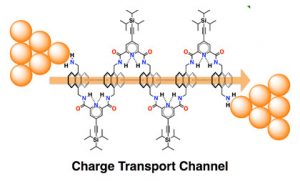
In the picture bellow, Dr. Marek Grzelczak, Dr. Guillermo Mínguez Espallargas, Martín Fañanás Mastral, Emilio J. Cocinero (from left to right).

Camilla Calabrese gave a talk at the “Biofisika” Institute
Camilla Calabrese gave a talk at the “Biofisika” Institue Open Day. She spoke about what we do at our laboratory, what kind of research lines we carry out and the instrumental facilities we have at hand.
In the photo, the poster used at the conference.

Emilio J. Cocinero was invited to Ulm University, Germany
Emilio J. Cocinero and Jorge Casanova (in the picture bellow) met at Ulm University, Germany. They had interesting discussions about new research lines.
Our research about Competing Dispersive Interactions accepted in JPCL
Modern structural studies of biologically relevant molecules require an exhaustive interplay between experiment and theory. In this work, we present two examples where a poor choice of the theoretical method led to a misinterpretation of experimental results. We do that by performing a rotational spectroscopy study on two large and flexible biomolecules: methyl jasmonate and zingerone. The results show the enormous potential of rotational spectroscopy as a benchmark to evaluate the performance of theoretical methods.
The investigation has been published in JPCL

Iciar Uriarte talks in the 25th International Conferences on High-Resolution Molecular Spectroscopy
Iciar Uriarte gave a talk about the conformational landscape of the sugar present in DNA in its biologically relevant form that has been studied combining chemical synthesis, supersonic expansions, quantum chemical calculations, microwave spectroscopy, NMR spectroscopy and Molecular Dynamics.

Aran Insausti talks in the 25th International Conferences on High-Resolution Molecular Spectroscopy
Aran Insausti presented the experimental and theoretical study of the Tn antigens in the gas, solution and solid phases that has been applied to deduce the key role of water in the modulation of the conformational preferences of these molecules and therefore in their presentations for interacting with protein receptors.
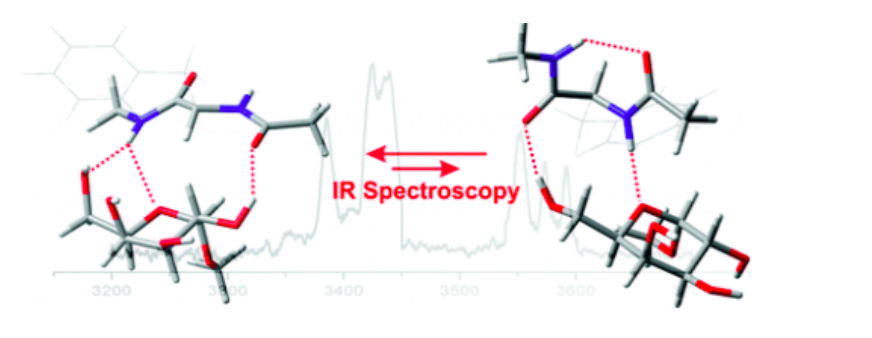
In the photo, IRID spectra of Tn-Thr* and Tn-Ser* Antigens (a) and conformation in solution of Tn-Thr and Tn-Ser (b).

Camilla Calabrese talks in the 25th International Conferences on High-Resolution Molecular Spectroscopy
Camilla Calabrese presented the study of the structure of large clusters of difluoromethane (CH2F2) combining state-of-the-art rotational spectroscopy and quantum chemical calculations, as well as the results obtained afterwards, highlighting the high sensitivity of the technique used.

Conferences on High-Resolution Molecular Spectroscopy
The 2018 Edition of the Prague Series of International Conferences on High-Resolution Molecular Spectroscopy was held in Bilbao (Spain) this September 3-7.
We presented recent results focused on solving various structural problems of Chemistry at the molecular level. In particular, the conformational landscape of large clusters and biomolecules, including sugars, glycopeptides and drugs have been studied by our group recently.
In the photo, the poster designed for the conference showing information about the wide MW facilities in our lab and previously mentioned researches we have been involved in.

Our research about the Tumor-Associated Carbohydrate Tn Antigens spotlight in JACS
We report that two seemingly similar variants of Tn antigens have very different conformations in water. Using interdisciplinary approaches, both experimental and computational, the team showed that the threonine-linked Tn antigen assumes a rigid form in solution and forms a persistent water pocket. In contrast, the serine-linked Tn antigen lacks the water pocket and is flexible in solution. These differences were not observed in gas phase studies.
The different Tn antigen conformations are likely to result in distinct interactions with cellular receptors and antibodies and understanding these structures may facilitate the design of more effective screening tools and anticancer drugs.
The investigation has been published in JACS.

Emilio J. Cocinero gives a talk in Kaiserslautern, Germany
Emilio J. Cocinero was invited by Markus Gerhards to Kaiserslautern, Germany, where he presented several studies on biomolecules (carbohydrates and glycopeptides) and several applications, exploiting an experimental strategy which combines microwave and laser spectroscopies in high resolution, computation and synthesis. In addition, other applications of high resolution spectroscopies were presented.
Emilio J. Cocinero gives a talk in The Biofisika Institute, Bilbao
Emilio J. Cocinero attended to the Biophysics Seminar in The Biofisika Institute in Bilbao. He presented several results on the conformational landscape of several carbohydrates, peptides and glycopeptides with different biological roles, which have been obtained due to the combination of Laser and Microwave spectroscopy and theoretical calculations.

Emilio J. Cocinero gives a talk in the ICMol, Valencia
Emilio J. Cocinero gave a talk at the Instituto de Ciencia Molecular (ICMol) in Valencia about several studies on carbohydrates exploiting an experimental strategy which combines microwave and laser spectroscopies in high resolution, computation and synthesis. Carlos Martí-Gastaldo was the host.
Spectroscopy Group of Basque Country University Structural study of biological molecules in the gas phase using Microwave Spectroscopy